Overview
The Golden Triangle of India refers to a popular tourist circuit that connects three major cities in northern India: Delhi, Agra, and Jaipur. This triangular route forms a classic itinerary that highlights some of the most iconic and culturally significant destinations in the country.
Each city in the Golden Triangle offers its own unique blend of history, architecture, culture, and cuisine, making it a favorite among travelers exploring India.
- Recommended by 98% of travelers
- Badge of Excellence
- Free cancellation up to 24 hours before
- Mobile ticket
What's included
Permits/ entrance fees of all sightseeing places which is to be visited from inside
Accompanied local guide/s services wherever require
5% GST Government of India Goods & Services Tax
Lunch
Evening tea/coffee with cookies/snacks at a local restaurant
Dinner
Breakfast
Exclusive Veena World Tour Manager Services throughout the tour.
Travel by comfortable Private air conditioned vehicle
05 nights hotel accommodation in a 3 Star hotel
Any upgradation in vehicle, hotel or hotel room category
Personal expense like porterage, laundry, telephone, shopping, alcoholic beverages, etc
Anything specifically not mentioned in the ‘Inclusion’ column
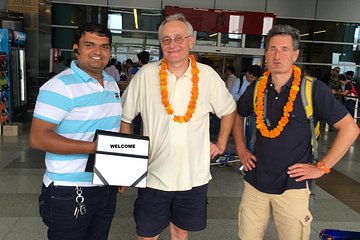
Meeting and pickup
Pickup is offered for all travelers.
What to expect
Day 1 Delhi
-
Agrasen Ki Baoli - Leamigo
30 min
Agrasen ki Baoli is a historical stepwell located in the heart of New Delhi, India. It is believed to have been built by the legendary king Agrasen during the Mahabharata era, though the exact date of its construction is uncertain. The stepwell is an architectural marvel, consisting of a series of steps leading down to a water reservoir.
Day 2 Delhi Sightseeing
-
Red Fort
2 hours Admission ticket included
The Red Fort, also known as Lal Qila, is a historic fort located in the heart of Delhi, India. It was constructed by the Mughal Emperor Shah Jahan in the 17th century and served as the main residence of the Mughal emperors for nearly 200 years, until the British colonial rule.
The fort is an architectural marvel, built with red sandstone and featuring intricate marble inlays, carvings, and a series of pavilions, halls, and gardens. Its design reflects a blend of Persian, Timurid, and Indian architectural styles. -
Jama Masjid
30 min
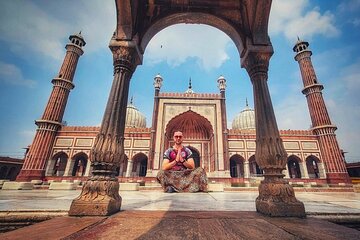
Jama Masjid, located in the heart of Old Delhi, is one of the largest and most renowned mosques in India. Commissioned by the Mughal Emperor Shah Jahan and completed in 1656, it is an architectural masterpiece that represents the pinnacle of Mughal architecture.
-
Pasar Chandni Chowk
1 hour
The name "Chandni Chowk" translates to "Moonlight Square," and it was designed and established by the Mughal Emperor Shah Jahan in the 17th century. The market was originally designed with a central square adorned with a pool to reflect moonlight, giving it its name.
Today, Chandni Chowk is famous for its eclectic mix of shops, selling everything from textiles, jewelry, and spices to electronics, books, and hardware. The area is particularly renowned for its street food, offering a wide variety of delicious snacks and dishes. Visitors can savor mouthwatering treats like parathas, chaat, samosas, jalebis, and more. -
Raj Ghat
20 min
Raj Ghat is a memorial dedicated to Mahatma Gandhi, the father of the Indian nation, located on the banks of the Yamuna River in Delhi, India. Raj Ghat is not only a place of remembrance but also a symbol of peace and unity. It attracts visitors from all over the world who come to pay their respects to Gandhi and to draw inspiration from his principles of truth, love, and non-violence.
-
India Gate
20 min
India Gate is a prominent war memorial located in the heart of New Delhi, India. It stands as a symbol of valor and sacrifice, commemorating the Indian soldiers who lost their lives fighting for the British Indian Army during World War I and the Third Anglo-Afghan War.
-
10 min
Rashtrapati Bhavan, formerly known as the Viceroy's House, is the official residence of the President of India. Located in the heart of New Delhi, it stands as an iconic symbol of India's democracy and is one of the largest presidential residences in the world.
-
Parliament House
10 min
The Parliament House of India, also known as Sansad Bhavan, is the seat of the Parliament of India, located in the heart of New Delhi. It is an iconic architectural landmark and the center of India's democratic governance.
-
Qutub Minar
1 hour Admission ticket included
The Qutub Minar is an iconic landmark located in Mehrauli, a neighborhood in South Delhi, India. It is the tallest brick minaret in the world and is recognized as a UNESCO World Heritage Site. The minaret stands at a height of 73 meters (240 feet) and is built with red sandstone and marble. It is adorned with intricate carvings, inscriptions in Arabic, and geometric patterns.
Day 3 Delhi - Agra (1 night) (4 hours Approx 230 Kms)
-
Taj Mahal
3 hours Admission ticket included
Today after breakfast continue your journey to the Historic City-Agra (takes around 5 Hrs Approx, 240 Kms).
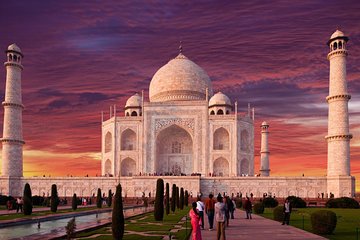
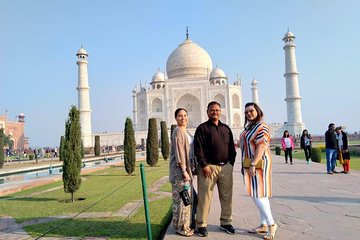
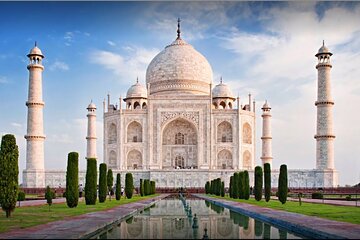
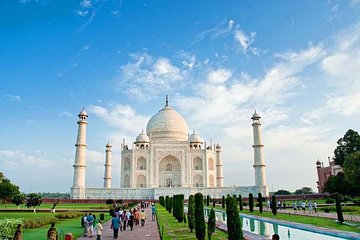
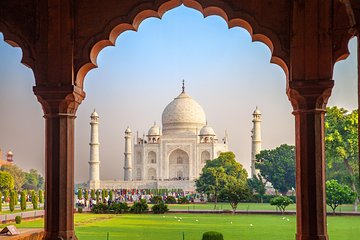
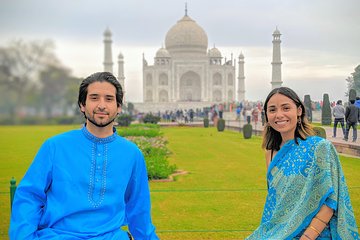
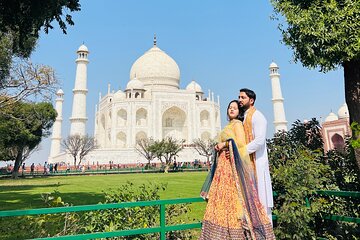
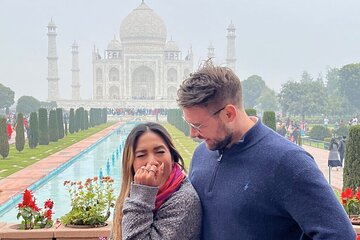
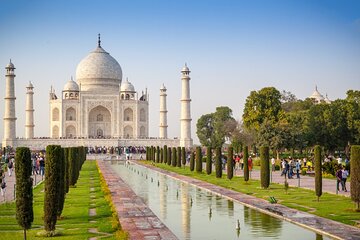
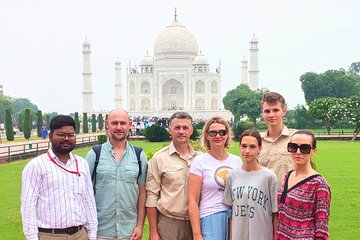
Agra is a UNESCO World Heritage Site and widely regarded as a masterpiece of Mughal architecture, renowned for its stunning beauty and exquisite craftsmanship. Commissioned by the Mughal Emperor Shah Jahan in memory of his beloved wife Mumtaz Mahal, the Taj Mahal was constructed between 1631 and 1653. It is built entirely of white marble, which was sourced from various regions of India and beyond. -
Agra Fort
2 hours Admission ticket included
The Agra Fort, also known as the Red Fort of Agra, is a UNESCO World Heritage Site located in Agra, Uttar Pradesh, India. It is a historical fortification built by the Mughal Emperor Akbar in the 16th century and later expanded and renovated by his successors, including Shah Jahan, who added many of its most famous structures.
Day 4 Agra - Jaipur (2 nights) (4.5 hours Approx 250 Kms)
-
Fatehpur Sikri
5 hours
Today, proceed to Jaipur (takes around 4.5 hours Approx 250 Kms). On our way to Jaipur stop at Fatehpur Sikri . Fatehpur Sikri is a historical city located near Agra in the state of Uttar Pradesh, India. It was founded by the Mughal Emperor Akbar in the 16th century and served as the capital of the Mughal Empire from 1571 to 1585. Fatehpur Sikri is renowned for its well-preserved architectural complex, which combines elements of Persian, Indian, and Islamic styles.
Day 5 Jaipur Sightseeing
-
Hawa Mahal - Palace of Wind
30 min Admission ticket included
Hawa Mahal, which translates to "Palace of Winds," is a stunning architectural marvel located in the heart of Jaipur, the capital city of Rajasthan, India. Built in 1799 by Maharaja Sawai Pratap Singh, The Hawa Mahal is renowned for its unique façade, which features a multitude of small windows, or "jharokhas," intricately decorated with latticework. These windows were designed to allow the royal ladies of the palace to observe street festivals and processions without being seen by the public, thus providing them with privacy while still enjoying the festivities and cool breeze.
-
City Palace of Jaipur
2 hours Admission ticket included
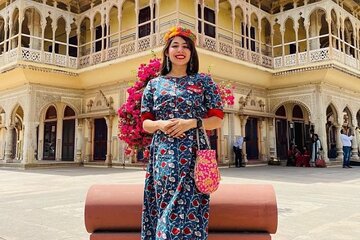
The City Palace of Jaipur is a magnificent complex located in the heart of the Pink City, Jaipur, Rajasthan, India. It is a symbol of the city's rich cultural heritage and royal legacy. Constructed in the 18th century by Maharaja Sawai Jai Singh II, the founder of Jaipur, the City Palace is a splendid example of Rajput and Mughal architecture.
The City Palace complex is a sprawling ensemble of palaces, courtyards, gardens, and buildings, showcasing a blend of Rajput, Mughal, and European architectural styles. -
Jantar Mantar - Jaipur
1 hour Admission ticket included
Jantar Mantar is an astronomical observatory located in Jaipur, Rajasthan, India. It is one of a collection of five observatories built by Maharaja Sawai Jai Singh II, the founder of Jaipur, in the early 18th century. The purpose of these observatories was to study celestial movements and accurately measure time.
-
Jaipur Block Printing
30 min Admission ticket included
Jaipur is famous for its traditional art of block printing, which has been practiced in the region for centuries. Block printing involves the use of intricately carved wooden blocks to stamp patterns and designs onto fabric, typically cotton or silk. It is a labor-intensive process that requires skill, precision, and creativity.
The block printing tradition in Jaipur is characterized by vibrant colors, intricate motifs, and meticulous craftsmanship. Artisans use natural dyes derived from plants, minerals, and other organic materials to create a rich palette of colors, including shades of indigo, red, yellow, and green. -
Panna Meena ka Kund
30 min Admission ticket included
Panna Meena ka Kund is a historic stepwell located in Jaipur, Rajasthan, India. Stepwells, also known as baolis or bawdis, are architectural marvels designed for the purpose of storing and accessing water, particularly during the dry seasons.
Panna Meena ka Kund is renowned for its intricate and symmetrical design, consisting of a series of steps leading down to the water level. The stepwell is believed to have been built during the 16th century and is named after the local community, the Panna Meena community, who were involved in its construction and maintenance. -
Amber fort
1 hour Admission ticket included
The Amber Fort, also known as Amer Fort, is a majestic fort located in Amer, a town near Jaipur in the state of Rajasthan, India. It is one of the most famous and visited forts in India, renowned for its stunning architecture, intricate carvings, and rich history.
Constructed by Raja Man Singh I, a trusted general of Emperor Akbar, in the late 16th century, the Amber Fort served as the primary residence of the Rajput rulers of Amer until the capital was shifted to Jaipur in the 18th century. The fort was later expanded and renovated by successive rulers, including Raja Jai Singh I and Sawai Jai Singh II. -
Sound and Light Show - Amber Fort
30 min Admission ticket included
The Sound and Light Show at the Amber Fort in Jaipur is a captivating evening spectacle that brings the history and grandeur of the fort to life through a combination of sound, light, and storytelling. Hosted in the stunning backdrop of the Amber Fort, illuminated against the night sky, the show takes visitors on a journey through the rich history and cultural heritage of Rajasthan.
The Sound and Light Show at the Amber Fort typically begins after sunset, with the fort illuminated in a mesmerizing display of lights. As the darkness sets in, the show unfolds, with narration, music, and sound effects accompanying the illumination of different parts of the fort.
Day 6 Jaipur - Delhi - Departure (5.5 hours Approx 300 Kms)
-
Bapu Bazar
30 min
Bapu Bazar is a bustling market located in the heart of Jaipur, the capital city of Rajasthan, India. It is one of the most popular shopping destinations in Jaipur, renowned for its vibrant atmosphere, traditional Rajasthani wares, and bustling streets lined with shops and stalls.
Named after Mahatma Gandhi, who is affectionately referred to as "Bapu" (meaning father), Bapu Bazar offers a wide variety of merchandise, including clothing, textiles, jewelry, handicrafts, footwear, and souvenirs. The market is particularly famous for its traditional Rajasthani attire, including colorful sarees, lehengas, bandhani fabrics, and embroidered garments.
Cancellation Policy
For a full refund, cancel at least 24 hours before the start time.
Times are local to the experience (Asia/Kolkata).
Additional Information
- Suitable for all physical fitness levels
- Mobile or paper ticket accepted
- Up to 15 travelers per booking
- Each booking must include at least one adult.
FAQs about 6 Days Golden Triangle India with Taj Mahal All Inclusive Tour
Can I cancel 6 Days Golden Triangle India with Taj Mahal All Inclusive Tour for free?
Yes. For a full refund, cancel at least 24 hours before the start time.
How long does it take?
It takes about 6 days.
Is pickup offered?
Pickup is offered for all travelers.
What's included?
- Permits/ entrance fees of all sightseeing places which is to be visited from inside
- Accompanied local guide/s services wherever require
- 5% GST Government of India Goods & Services Tax
- Lunch
- Evening tea/coffee with cookies/snacks at a local restaurant
- Dinner
- Breakfast
- Exclusive Veena World Tour Manager Services throughout the tour.
What's not included?
- Any upgradation in vehicle, hotel or hotel room category
- Personal expense like porterage, laundry, telephone, shopping, alcoholic beverages, etc
- Anything specifically not mentioned in the ‘Inclusion’ column
Which places does it visit?
It visits Agrasen Ki Baoli - Leamigo, Red Fort, Jama Masjid, Pasar Chandni Chowk, Raj Ghat, India Gate, Parliament House, Qutub Minar.
Which languages is it offered in?
It is offered in Hindi, English.
What fitness level is needed?
It is suitable for all physical fitness levels.
Is it suitable for children?
Children must be accompanied by an adult.
Operated by Veena World